When I tell parents that we see children as young as three for airway consultations, the reaction is usually some combination of surprise and skepticism. Three seems very young to be thinking about orthodontics. Surely there is time to wait and see.
I want to explain why we start this early and what the evidence says about why earlier is better. It’s not because we want to put appliances in the mouths of toddlers, but because the earlier we identify a problem that is affecting how a child breathes and sleeps, the sooner we can do something about it.
What sleep deprivation does to a growing child
A child who is not sleeping well because their airway is compromised is not just tired. They are running on a fundamental deficit that affects almost every system in their developing body.
Growth hormone is released primarily during deep sleep. A child with sleep-disordered breathing who is not reaching or sustaining deep sleep stages is receiving less growth hormone than they should be. This affects not just height but the growth of the jaw, the face, and the brain.
The brain consolidates learning and memory during sleep. A child who is not sleeping deeply is not retaining what they learn the same way a well-rested child does. This has direct consequences for academic performance and cognitive development, and it begins affecting children from the earliest years of life, not just after they start school.
The immune system is regulated in part by sleep. Children who sleep poorly get sick more often, recover more slowly, and are more likely to experience chronic low-grade inflammation that affects everything from mood to energy to behavior.
Every day a child with sleep-disordered breathing is not sleeping optimally is a day their development is less than it could be. That is not alarmist. It is what the research shows, consistently, across multiple decades of study.
Why earlier intervention captures more growth
The jaw grows rapidly in the early childhood years. That growth is both an opportunity and a window. A jaw that is too narrow or growing in the wrong direction during these years is setting a structural pattern that becomes harder to change as time passes.
Treating a three or four year old is not about placing a device and expecting them to tolerate it perfectly. It is about identifying what is happening early, monitoring it carefully, and intervening at the point when the intervention is simplest and the benefit is greatest.
For some young children, the most important early intervention is myofunctional therapy, exercises that address tongue posture, lip seal, nasal breathing habits, and swallowing patterns before any hardware is involved. Teaching a child to keep their lips together and breathe through their nose, to rest their tongue on the roof of their mouth, and to swallow correctly builds the functional habits that support healthy jaw development as they grow.
For children who need structural intervention, placing a simple palatal expander at age five or six is a considerably different procedure than the surgically-assisted expansion that would be needed at twenty-five. The earlier the intervention, the simpler and less invasive the treatment.
The glasses comparison
I use this comparison regularly with parents and I find it helps.
When a child is diagnosed with myopia and needs glasses, we do not wait until they are twelve or fourteen to treat them. We give them glasses now, understanding that their prescription will likely change as they grow and that they may need new glasses in a few years. We give them glasses now because they cannot see well right now, and their ability to learn, read, and develop depends on being able to see. We address the current problem for their current stage of development.
The same logic applies to airway treatment. A child who cannot breathe and sleep well right now is being affected right now. Helping them breathe and sleep better at age three or four does not guarantee they will never need further treatment. Their jaw will continue to grow and the picture may change. But it helps them for where they are right now, during a period of development when sleep quality has profound consequences.
Waiting because the child might grow out of it, when the evidence suggests that untreated airway restriction typically does not resolve on its own and that the consequences of untreated sleep disruption compound over time, is not a neutral choice. It is choosing to let a child continue to develop under conditions that are less than optimal when intervention is available.
What we actually do at a consultation for a young child
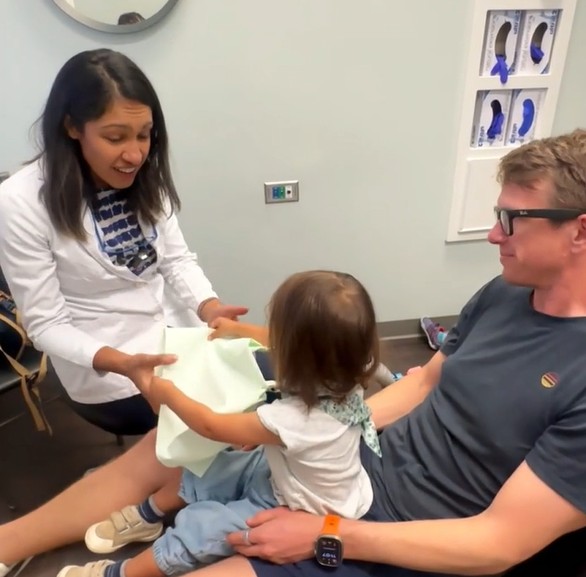
For children between ages three and five, choosing the right kids dentist is an important part of making dental and airway evaluations feel comfortable. At Mint Hill Smiles, the consultation is gentle, unhurried, and focused on gathering information without doing anything invasive. We use the sleep questionnaire, a clinical exam, and our clinical observations to assess what is happening. A CBCT may or may not be indicated at this age, depending on the clinical findings. We talk with parents about what we are seeing and what, if anything, we recommend at this stage..
Many young children benefit from a monitoring approach with guidance on myofunctional habits first, with more formal treatment coming as they grow. In others, early intervention is clearly warranted. We tailor the approach to what we actually find.
Call (704) 323-7577 or visit minthillsmiles.dentist to schedule an airway consultation. We are at 11300 Cresthill Drive, Suite 105, Mint Hill, NC 28227.