Wisdom Teeth Removal in Mint Hill, NC | Mint Hill Smiles

Wisdom Teeth Removal in Mint Hill, NC

Wisdom teeth are one of the most common reasons people end up in a dental chair in their late teens and twenties

And one of the most commonly misunderstood dental topics at the same time. Not every wisdom tooth needs to come out. Not every dentist should be taking them out. And not every patient who is in pain needs to wait weeks for a surgical appointment.

At Mint Hill Smiles we evaluate wisdom teeth for every patient who needs it and we handle extractions for cases that are straightforward and appropriate for a general dentistry setting. For more complex cases, impacted teeth, difficult anatomy, and situations that call for the skill of someone who does oral surgery every single day, we refer to trusted oral surgeons in the area who we are confident will take excellent care of you.

We think that approach is better medicine than extracting every wisdom tooth that walks through our door regardless of complexity, and we will explain exactly why when you come in.

The Reality

What Wisdom Teeth Are and Why They Cause Problems

Wisdom teeth are the third molars, the last set of permanent teeth to develop, typically emerging between the ages of 17 and 25. Most people have four of them, one in each corner of the mouth, though some people have fewer and a small number never develop them at all.

The problem is that most modern human jaws simply do not have enough room for them. As wisdom teeth grow in, or attempt to grow in, they frequently encounter the teeth already occupying that space at the back of the mouth. The result is pressure, pain, and a range of complications that do not resolve on their own.

An impacted wisdom tooth is one that cannot fully emerge because it is blocked by the tooth next to it, the jawbone, or both. Partial impaction, where the tooth partially breaks through the gum but cannot come in fully, creates a piece of gum tissue over the tooth that becomes a trap for food and bacteria. Infection in that tissue is called pericoronitis. It causes swelling, pain, and difficulty opening the mouth and is one of the most common acute reasons patients call us about wisdom teeth.

Wisdom teeth that do come in fully are not automatically problem-free. They are difficult to clean effectively because of their position at the back of the mouth, which makes them significantly more prone to cavities and gum disease than any other tooth.

When Wisdom Teeth Actually Need to Come Out

This is a more nuanced question than most patients expect and we want to answer it honestly.

Not every wisdom tooth needs to be removed. Wisdom teeth that have fully erupted, are positioned correctly, are accessible for cleaning, and are not causing any problems to the neighboring teeth or surrounding bone can sometimes stay without issue. Whether your wisdom teeth qualify for that category requires a proper evaluation with current X-rays.

Wisdom teeth that typically DO need to come out include:

  • – Wisdom teeth causing acute pain or infection
  • – Wisdom teeth that are partially erupted and chronically trapping bacteria
  • – Wisdom teeth whose position or angle is causing damage to the adjacent second molar
  • – Wisdom teeth that are fully impacted in the bone in a way that is creating problems with the surrounding structures
  •  

Some dentists recommend removing all wisdom teeth prophylactically in the late teens before problems develop, because younger patients heal faster and the roots are not yet fully formed, making extraction technically easier. That is a reasonable conversation to have. We are also comfortable taking a monitoring approach for wisdom teeth that are not currently causing problems, evaluating them at regular intervals and recommending removal if the picture changes. We will tell you honestly what we think makes sense for your specific situation rather than defaulting to a one-size-fits-all recommendation.

When We Handle It and When We Refer

We extract wisdom teeth in-office when the case is appropriate for a general dentistry setting,  meaning the tooth is fully erupted or minimally impacted, the roots are in a straightforward position away from the nerve canal, and the extraction can be done comfortably and safely with local anesthetic. For patients who are in pain from an erupted or partially erupted wisdom tooth that is causing a problem we can address here, we will get you in quickly and take care of it.

We do not offer sedation for wisdom tooth removal. Our extractions are performed under local anesthetic, and for straightforward cases that is entirely appropriate and well tolerated by most patients. If you have significant dental anxiety or your case involves multiple impacted wisdom teeth, you will be better served by an oral surgeon who has sedation available and who performs complex extractions as the primary focus of their practice every day.

We refer impacted wisdom teeth cases, cases where the roots are in proximity to the inferior alveolar nerve, cases involving significant surgical complexity, and cases where sedation is important to the patient’s comfort and safety. This is not a limitation we are embarrassed about, it is a reflection of doing right by patients. An oral surgeon who extracts fifty teeth a week has a level of technical proficiency with complex cases that a general dentist simply cannot match. When we refer you, we refer you to someone we trust and have worked with for years.

What Your Evaluation Looks Like

When you come in with wisdom tooth concerns, we start with an x-ray if you do not have a current one. Sometimes we need to take a panoramic x-ray or a CBCT x-ray to see all four wisdom teeth, the position of their roots, the relationship to the nerve canal below, the condition of the adjacent second molars, and the amount of bone surrounding each tooth.

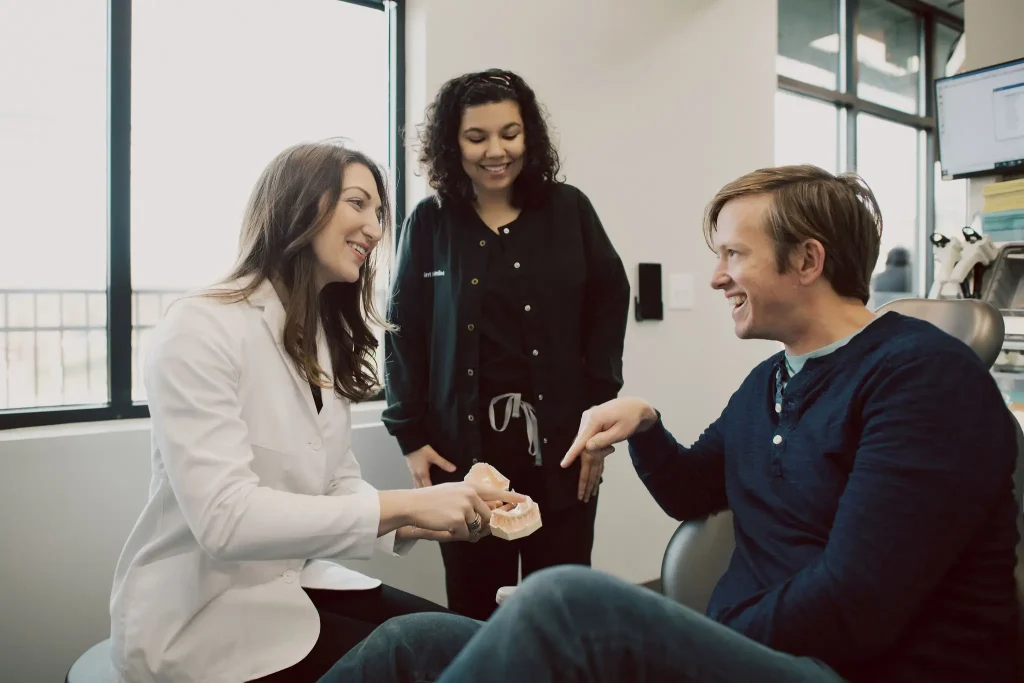
We review your x-rays with you so you can see exactly what is going on before we make any recommendations. If the case is one we can handle here, we explain what the extraction involves, what the recovery looks like, and what it will cost before we schedule anything. If the case calls for a referral, we tell you why and give you a specific recommendation rather than just sending you off to find someone on your own.

If We Do Your Extraction: What to Expect

For the cases we do handle in-office, the extraction process is the same thorough, patient-centered approach we bring to every procedure at Mint Hill Smiles.

We numb the area completely before we do anything. You should not feel pain during the extraction, pressure and movement are normal, but sharp pain means we stop and address it. We use our CBCT imaging when indicated to confirm root position before we begin. The extraction itself typically takes between 20 and 45 minutes for a single tooth depending on the position and root anatomy.

After the extraction we provide detailed post-operative instructions before you leave and we are available by phone if anything feels off during recovery.

Recovery from a straightforward single wisdom tooth extraction at a general dentist is typically manageable with over the counter pain relief. Most patients feel well enough to return to normal activities within two to three days. Swelling peaks around 48 to 72 hours and then gradually resolves. We follow up with you after the procedure to make sure healing is progressing normally.

FAQ

Frequently Asked Questions About Wisdom Teeth

No. Some wisdom teeth never cause problems and can stay indefinitely with regular monitoring. Others need to come out before they cause damage. The answer depends on your specific anatomy, how your wisdom teeth are positioned, and whether they are affecting the health of your surrounding teeth and bone. An evaluation with current imaging is the only way to know.
Most dentists recommend a panoramic X-ray to evaluate wisdom tooth development somewhere between ages 16 and 20, before the roots are fully formed and while healing is fastest. That said, wisdom teeth cause problems at any age and an evaluation is worthwhile at any point if you are experiencing symptoms.
Dry socket occurs when the blood clot that forms in the extraction socket becomes dislodged or dissolves before the tissue has healed over the site, exposing the underlying bone. It is the most common complication following wisdom tooth extraction and it is painful. Avoiding straws, smoking, and vigorous rinsing for the first week significantly reduces the risk. PRF therapy, which we offer at the time of extraction, also substantially reduces dry socket incidence by supporting the healing process with your own growth factors.
Cost depends on whether the tooth is fully erupted or impacted, how many teeth are being removed, and whether bone grafting or PRF is included. We give you a complete cost breakdown before scheduling. Most dental insurance plans provide partial coverage for wisdom tooth removal. We verify your benefits before your appointment so you know what to expect.

Tell us. For straightforward extractions done under local anesthetic, anxiety is something we manage through communication, pacing, and a team that takes your comfort seriously. If your anxiety is significant enough that you feel you need sedation to get through the appointment comfortably, we will be honest with you about whether a referral to an oral surgeon with sedation available is the better choice. Your comfort and your outcome both matter.

For simple extractions most patients prefer to take the rest of the day off and return to desk work the following day. More physically demanding work may require two to three days. We will give you a specific recommendation based on what your extraction involves.

Start With an Evaluation

If you are having wisdom tooth pain, swelling, or you have been told your wisdom teeth need attention, the right first step is coming in for an evaluation. We will look at what is actually going on, tell you honestly what we think needs to happen, and make sure you end up in the right hands, whether that is ours or a surgeon we trust, to get it taken care of properly.

Call (704) 323-7577 or visit minthillsmiles.dentist to schedule. We are at 11300 Cresthill Drive, Suite 105, Mint Hill, NC 28227. We serve patients from Mint Hill, Matthews, Indian Trail, Stallings, Weddington, Midland, Albemarle, and southeast Charlotte, NC. Same day appointments are available for patients in acute pain.