Most people who come in comparing veneers, bonding and crowns have already priced all three and assume the decision is a financial one. It usually isn’t. These are three different tools for three different problems, and picking on price alone is how people end up with the wrong one.
Here’s how we actually decide.
Start with what is wrong with the tooth
Before anyone talks about materials, the question is whether the problem is on the surface of the tooth or inside it.
A surface problem is about how the tooth looks. Its color, its shape, a chipped edge, a small gap, a tooth that sits slightly back from its neighbors. The tooth itself is sound.
A structural problem is about whether the tooth can hold up. A crack, a large old filling with not much tooth left around it, a tooth that has had root canal treatment and is now brittle.
Veneers and bonding fix surface problems. Crowns fix structural ones. That single split rules out the wrong answer in most cases before cost comes into it.
What a veneer is for
A veneer is a thin shell of porcelain bonded to the front of a tooth. It changes what you see from the front and leaves the back of the tooth alone.
It’s the right choice when several front teeth need their shape, length or color changed together, when staining sits deep in the tooth where whitening can’t reach it, or when you want a result that keeps its color for ten to fifteen years without much thought.
The catch is permanence. Preparing a tooth for a veneer removes a small amount of enamel, and enamel doesn’t grow back, so that tooth stays covered for good. That’s not a reason to avoid porcelain veneers. It’s a reason to be sure.
What bonding is for
Composite bonding is tooth colored resin shaped straight onto the tooth in one visit. In most cases nothing is drilled away, so it can be polished, added to or removed later.
Bonding wins on one or two teeth, a small chip, a narrow gap, an edge that has worn uneven, or for anyone who wants to try a change before committing to something permanent. It costs less up front.
What it gives up is durability and stain resistance. Resin picks up coffee and red wine over time and usually needs refreshing after five to seven years. Porcelain doesn’t.
It’s also the most under-recommended option of the three. A single chipped corner almost never needs a veneer, and if you’ve been quoted one for that, a second opinion is worth the time.
What a crown is for
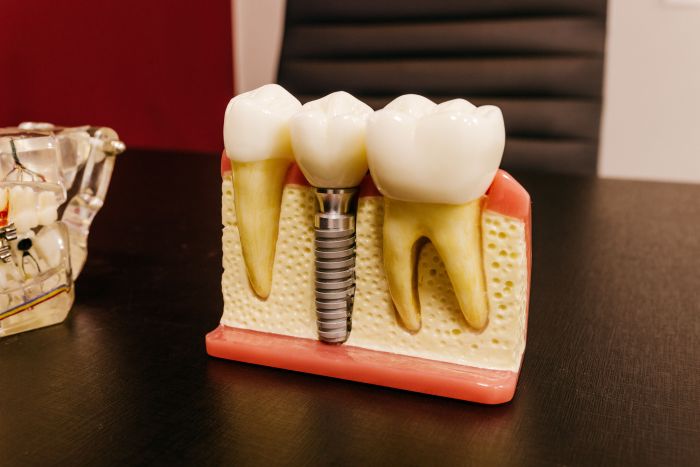
A crown covers the whole tooth, top and sides. It’s a structural repair, not a cosmetic one, even though a good porcelain crown looks like a natural tooth.
You need one when there isn’t enough healthy tooth left to hold a filling or support a veneer. Cracked teeth, teeth with very large fillings, and back teeth after root canal treatment are the usual cases. Covering all sides holds the tooth together under biting pressure.
Crowns remove more tooth than a veneer does, because the whole outside surface is reshaped. So they’re the wrong answer for a tooth that is healthy and simply the wrong color. If you need one, though, a veneer isn’t an alternative. A veneer bonded to a cracked tooth will fail along with it.
At our practice a crown can often be designed and milled in-house in a single visit. A crown made in-house avoids weeks in a temporary.
The quick way to tell them apart
- The tooth is healthy and you want it to look different: bonding or a veneer.
- One or two teeth, small change, want it reversible or cheaper: bonding.
- Several front teeth, bigger change, want it to last: veneers.
- The tooth is cracked, heavily filled or root treated: a crown.
That covers most situations. The rest are the ones worth a proper look in the chair.
Where cost actually fits
Cost is real, and it matters, but it comes after the clinical choice rather than before.
Per tooth, bonding is the least expensive of the three. Porcelain veneers and crowns cost more because they involve a lab or milling, more appointments and more precise preparation. A crown on a back tooth is also more likely to have insurance coverage, because it’s restoring function. Veneers and cosmetic bonding usually aren’t covered, because they’re classed as elective.
If you want the numbers, we’ve laid out what veneers cost here, including what pushes a quote up or down.
The mistake to avoid is choosing the cheaper option for a problem it can’t solve. Bonding over a cracked tooth or a veneer over a large failing filling saves money for about a year.
Mixing them is normal
Plenty of smiles end up with more than one. A crown on a back tooth that cracked, bonding on a chipped lateral incisor, and whitening across the rest is a perfectly ordinary plan.
The thing to watch is shade. Porcelain and composite don’t change color with whitening gel, so if your natural teeth are going to be whitened, that has to happen first. Then the crown, veneers or bonding are matched to the new shade. Do it the other way round and the new work stops matching the moment the natural teeth brighten.
Questions worth asking at a consultation
Ask whether the problem is surface or structure, and why the dentist thinks so. Ask what happens to the tooth underneath and whether any enamel comes off. Ask whether bonding would get you close enough. Ask how long each option is expected to last in your mouth, given your bite and whether you grind.
And ask for the plan and the figure in writing before you agree to anything.
The American Dental Association has plain-language material on crowns, veneers and bonding if you want to read more before you come in.
Call (704) 323-7577 and we’ll look at the tooth with you and tell you plainly which of the three it needs.