If you’ve lost a tooth, or you’re about to, there are really only two fixed ways to fill the gap: a bridge or an implant. Both look like a natural tooth, both stay in your mouth permanently, and both can last for many years. The difference lies in what each one does to the teeth and bone around it, and that’s the part most people don’t hear about until after they’ve chosen.
This is how we walk patients through the decision, including the situations where a bridge is genuinely the better answer.
The short answer
For a single missing tooth with healthy teeth on either side, an implant is usually the stronger long-term choice, because it replaces the root as well as the tooth and leaves the neighboring teeth untouched. A bridge makes more sense when the teeth on either side already need crowns, when there isn’t enough bone for an implant and you’d rather avoid grafting, or when your health makes oral surgery a poor idea.
How a bridge works
A traditional bridge is three crowns joined together. The two outer crowns are cemented onto the teeth either side of the gap (the “abutment” teeth), and the middle crown sits on the gum where the missing tooth used to be. To fit those outer crowns, both neighboring teeth have to be shaped down, which means removing healthy enamel from teeth that may have had nothing wrong with them.
That trade-off is the whole story with bridges. If the neighboring teeth already have large fillings or need crowns and bridges work anyway, shaping them costs you very little and the bridge does two jobs at once. If they’re healthy, you’re taking two good teeth and committing them to crowns for life so they can hold up a third.
How an implant works
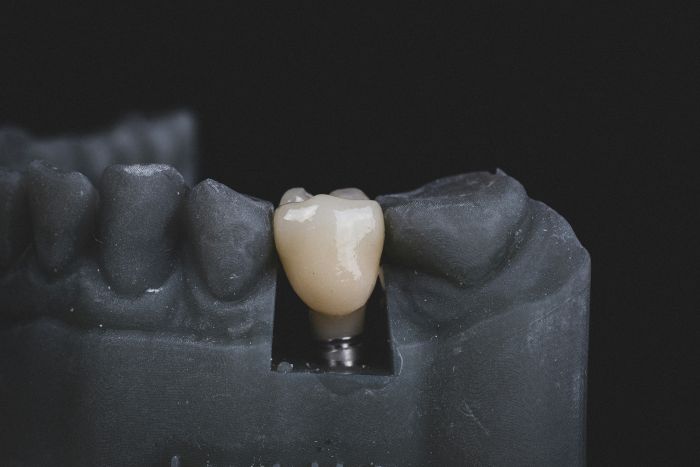
An implant is a small titanium post placed into the jawbone where the root used to be. Over the following months the bone grows tightly around it, and once it’s stable a crown is attached on top. Nothing is done to the teeth next door, and because the implant sits in the bone, it gives the jaw the same kind of load a natural root would.
The catch is time and surgery. An implant needs enough healthy bone to anchor into, it needs a healing period before the final crown goes on, and it involves a minor surgical procedure. For most healthy adults that’s very manageable, but it isn’t nothing, and it’s why the planning stage matters so much.
Bridge vs implant at a glance
| Dental bridge | Dental implant | |
|---|---|---|
| Neighboring teeth | Shaped down to hold crowns | Left untouched |
| Jawbone under the gap | Continues to shrink | Stimulated by the implant, so it’s preserved |
| Treatment time | Usually a few weeks | Usually several months, including healing |
| Surgery | None | Minor surgical placement |
| Upfront cost | Often lower | Often higher |
| Cleaning | Needs a floss threader or water flosser under the bridge | Brush and floss like a natural tooth |
| Most common long-term problem | Decay or nerve problems in the supporting teeth | Gum and bone inflammation around the implant if hygiene slips |
Which one lasts longer?
This is the question everyone asks, and the honest answer is that both hold up well when they’re done properly. The best-known comparison is a large review of long-term studies published in Clinical Oral Implants Research, which estimated that after 10 years about 89% of conventional bridges and about 89% of single implant crowns were still in place. At five years the figures were roughly 94% for both.
So survival alone doesn’t settle it. What separates them is how they fail. In the same research, the most common problems with bridges were biological ones in the supporting teeth, mainly decay and loss of the nerve, which can mean a root canal or losing an abutment tooth. When that happens, you’re no longer replacing one tooth, you’re replacing three. Implant problems tend to be mechanical or gum-related, and are often fixable without losing anything else. Cantilever bridges, which are anchored on one side only, did noticeably worse, with around 80% still in place at 10 years.
What happens to the bone if you choose a bridge
This is the part that tips the balance for a lot of patients. A natural tooth root stimulates the bone around it every time you bite. Take the root away and the body starts reclaiming that bone, and it happens faster than most people expect: one widely cited study found the ridge lost around half its width within the first 12 months after an extraction, with about two-thirds of that change in the first three months.
A bridge sits on top of the gum, so it doesn’t stop this process. Over the years the gum under the bridge can recede and leave a visible gap or a dark triangle, especially in the front of the mouth. An implant replaces the root, so the bone around it has a reason to stay.
The timing point matters too. If you’re weighing up an implant, waiting a year after an extraction can mean the difference between a straightforward placement and needing a bone graft first. If a tooth is coming out, it’s worth talking about the replacement before the extraction, not after.
What each one costs
Upfront, a bridge is often cheaper. In the Charlotte area, a single dental implant including the post, abutment and crown typically runs from about $3,500 to $7,000, with a bone graft adding to that if one is needed.
Over 15 or 20 years the comparison changes. A bridge that fails because an abutment tooth develops decay often means a root canal, a new bridge, or a longer bridge to replace the lost tooth as well. An implant that’s looked after typically just needs its crown replaced at some point. That doesn’t make an implant cheaper for everyone, but it does mean the day-one price is the wrong number to compare on its own.
Dental insurance often covers a portion of a bridge, while implant coverage varies widely by plan, so it’s worth checking your benefits before you decide. Our front desk can do that for you before any treatment starts.
When a bridge is the better choice
We recommend implants often, but not by default. A bridge is usually the better call when:
- The teeth either side of the gap already have large fillings or crowns that need replacing anyway.
- There isn’t enough bone for an implant, and a graft isn’t something you want to go through.
- You have health conditions or medications that make oral surgery or bone healing less predictable, such as uncontrolled diabetes or some bone-density medications.
- You need the gap filled quickly, for example before an event, and can’t wait out an implant’s healing period.
- You smoke heavily and aren’t planning to stop, which raises the risk of implant problems.
When an implant is the better choice
- The neighboring teeth are healthy and you’d rather not crown them.
- You have enough bone, or the tooth is still in place and the implant can be planned at the same time as the extraction.
- You’re looking for the option most likely to still be working in 20 years without involving other teeth.
- The gap is in a spot where the gum line will show, and you want to avoid the recession that can follow a bridge.
How we help you decide
Most of the guesswork disappears once we can see the bone. We take a 3D cone beam scan in the office, which shows the height, width and density of the bone where the implant would go, and how close it sits to nerves and sinuses. From that scan we can tell you whether an implant will work as things stand, whether you’d need a graft first, and how long the whole process would realistically take.
Then we lay out both options side by side with your costs, including what your insurance is likely to cover. Sometimes the answer is obviously an implant, sometimes it’s obviously a bridge, and sometimes it’s genuinely close and comes down to your priorities. Either way, you’ll know exactly what you’re choosing and why.
Thinking about replacing a missing tooth?
If you’re local to Mint Hill, Matthews or the surrounding area and you’re weighing up a bridge against an implant, book a consultation at Mint Hill Smiles. We’ll scan, explain what we see in plain English, and give you a clear plan with costs before anything starts. Call us on (704) 323-7577 or book online.