If you have been told you need a dental implant and your dentist has mentioned ordering a CBCT scan before the procedure, you might be wondering what that is and why it matters. It is a fair question and you should understand the answer before you sit in the chair.
A CBCT scan, cone beam computed tomography, is a type of three-dimensional imaging that gives your dentist a complete picture of your jaw, bone structure, nerve canals, sinuses, and surrounding anatomy before a single drill touches anything. It is one of the most important diagnostic tools in modern implant dentistry and it is available right here at Mint Hill Smiles.
What a standard dental X-ray cannot show you
Most people are familiar with traditional dental X-rays, the small films or digital sensors your hygienist places in your mouth to capture images of individual teeth and areas between them. These two-dimensional images are useful for detecting cavities, checking bone levels, and evaluating the roots of individual teeth. For a lot of routine dental work, they are exactly what is needed.
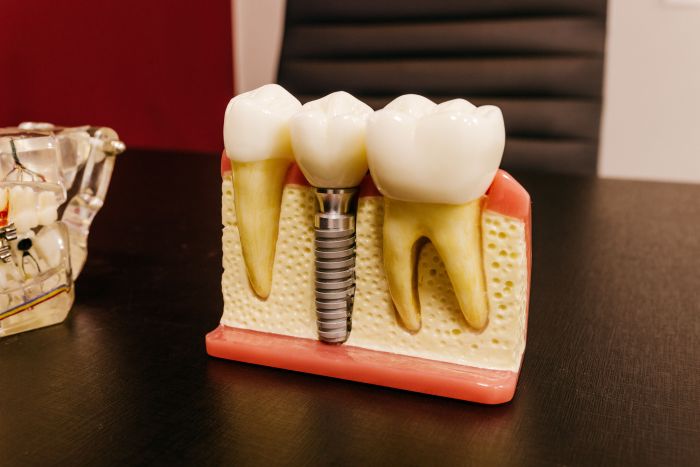
But a two-dimensional image has real limits when you are planning something as precise as a dental implant. An implant post is placed directly into the jawbone. The surgeon needs to know the depth and width of the available bone, whether the bone density is adequate to support the implant, exactly where the inferior alveolar nerve runs beneath the lower jaw, how close the sinus floor sits in the upper jaw, and how the anatomy of the site relates to the adjacent teeth. A traditional X-ray gives you a partial picture of some of these things. A CBCT scan gives you the full picture of all of them, in three dimensions.
What a CBCT scan actually does
A CBCT scanner rotates around your head and captures hundreds of images from different angles in a single pass. Those images are compiled by software into a complete three-dimensional model that your dentist can view from any angle, measure precisely, and use to plan the procedure in detail before the appointment begins.
The difference between planning an implant from a standard X-ray and planning it from a CBCT scan is a bit like the difference between navigating with a flat paper map versus a three-dimensional GPS model. Both give you information. One gives you a complete picture of the terrain.
At Mint Hill Smiles we use the Vatech Green CT 2, which produces high-resolution three-dimensional images while keeping radiation exposure low. The scan takes less than a minute and is completely non-invasive. You stand still, the machine rotates, and within moments your doctor has a detailed model of your anatomy to work from.
Why this matters for your implant
The precision that comes from three-dimensional planning has direct consequences for your outcome.
Before a CBCT scan, an implant surgeon is working with incomplete information and relying heavily on two-dimensional estimates of where critical structures like the inferior alveolar nerve sit. Placing an implant too close to that nerve can cause numbness, tingling, or pain that can be long-lasting or permanent. Placing an implant in an area with insufficient bone depth or width can lead to implant failure. These are complications that careful three-dimensional planning significantly reduces.
With a CBCT scan, your doctor can measure the available bone depth and width at the exact site. They can identify where the nerve canal runs and plan the implant position to maintain a safe margin. They can evaluate the bone density to determine whether the site is ready for placement or whether additional procedures like bone grafting would improve the outcome. And they can design a surgical guide, a custom-fitted device that directs the drill to the precise position and angle planned digitally, so that what was planned on screen is executed with accuracy in the chair.
At Mint Hill Smiles we use surgical guides for implant placement specifically because of the precision they add to what the CBCT planning makes possible.

We also use CBCT for airway evaluation
Implant planning is the most common reason we use our CBCT scanner, but it is not the only one. We also use it for airway evaluation through our Sleep Better Charlotte pediatric airway orthodontics program. A CBCT gives us a three-dimensional view of a child’s airway, jaw, and palate that a standard X-ray cannot provide, which helps us identify structural issues that may be affecting breathing and sleep. If you have a child who has been referred for an airway consultation, the CBCT is often part of how we get a complete picture of what is happening before we make any treatment recommendations.
What to expect if your dentist recommends a CBCT scan
The scan itself is quick and non-invasive. You stand or sit in the machine, hold still for less than a minute while it rotates, and that is the full procedure from your perspective. There is nothing placed in your mouth and no discomfort. The radiation dose from a CBCT scan is higher than a standard dental X-ray but considerably lower than a medical CT scan and well within the range considered safe for diagnostic purposes.
Having this imaging done before your implant appointment means your doctor walks into that procedure having already mapped out exactly what they are doing. That preparation is what makes a complex procedure feel routine and what protects you from the complications that can arise when it is not done.
If you have questions about CBCT imaging or would like to schedule an implant consultation at Mint Hill Smiles, call us at (704) 323-7577 or visit minthillsmiles.dentist. We are at 11300 Cresthill Drive, Suite 105, Mint Hill, NC 28227. We serve patients from Mint Hill, Matthews, Indian Trail, Stallings, Weddington, Midland, Albemarle, and southeast Charlotte, NC.